
Mazda and Pfizer Paid an Influencer Thousands to Reach an Audience That Barely Exists
Influencers are charging thousands of dollars to post to almost no one. Is your brand paying for an audience that isn't there?
By Creator Receipts · July 14, 2026 · 12 min read
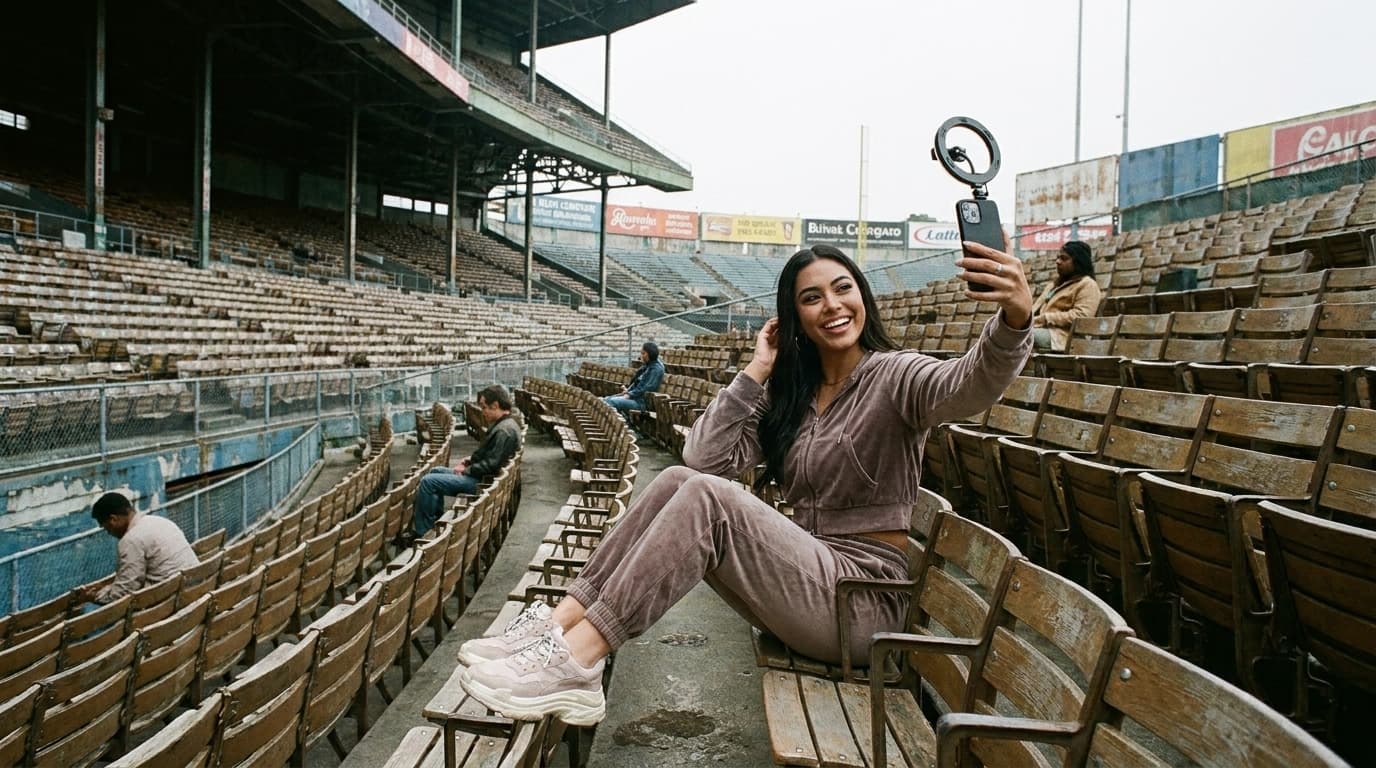
What do Mazda, Pfizer, and Reproductive Freedom for All have in common?
They all recently paid the same influencer thousands of dollars to reach an audience that barely exists. They're not alone, and they're not careless. They did everything the industry playbook told them to do. That's the problem.
US brands will pay social media influencers $12 billion dollars this year to post about their products. A market that big is guaranteed to attract fraud. What it hasn't attracted is anyone whose job it is to catch it.
To show you just how desperately this industry needs help checking their receipts, I'm going to show you how 19 of the most recognizable brands in America paid an influencer thousands of dollars to post to an audience that was barely there. The influencer's handle is Elleisalwayshere. Elle didn't agree to help with this story, exactly, but her public data and self-identification as a "public figure" did.
Elle is a beauty and lifestyle influencer with 238,000 followers, based in New York City, and she has posted for brands 22 times in the last 60 days. Run her through a standard creator vetting tool and her engagement rate comes back at about 0.5%. That's the low side of normal for an account her size, nothing that trips an alarm. She has a partnerships email in the bio, three monetized links, and recent brand work visible right on her grid. If you're the person at CeraVe with a campaign to fill and fifty creators to evaluate before lunch, Elle is a quick yes. You followed the process. The process is the problem.
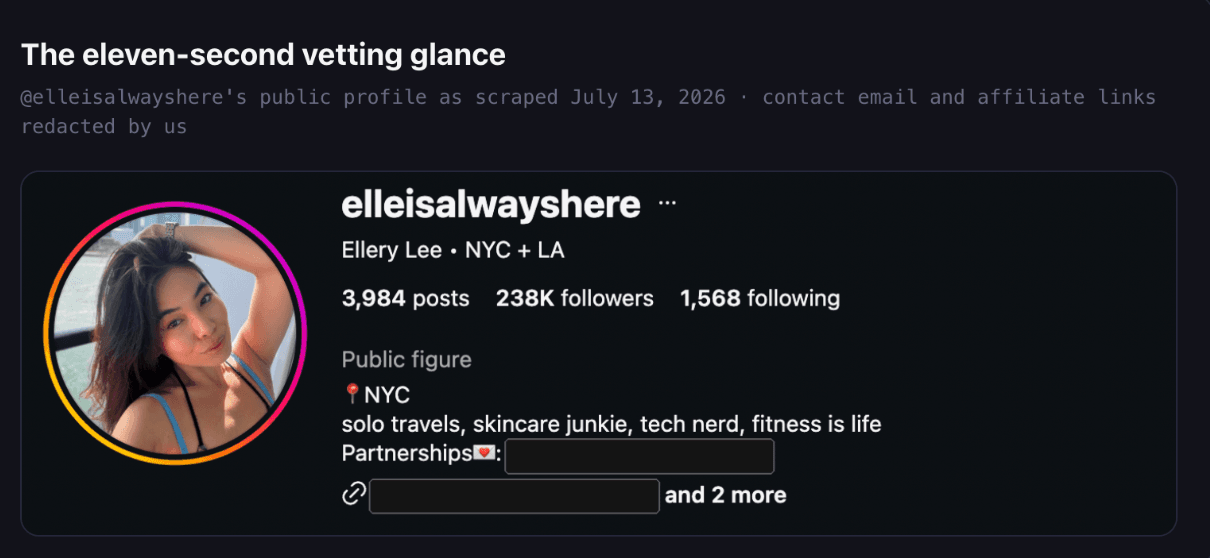
Everything you're about to see comes straight from her public Instagram, organized from questionable to downright absurd. No leaks, no sources, no subpoenas. Which is the unsettling part: if this was sitting in the open the whole time, what are the influencer management tools brands pay thousands for even doing?
Question 1: how much are these people getting paid?
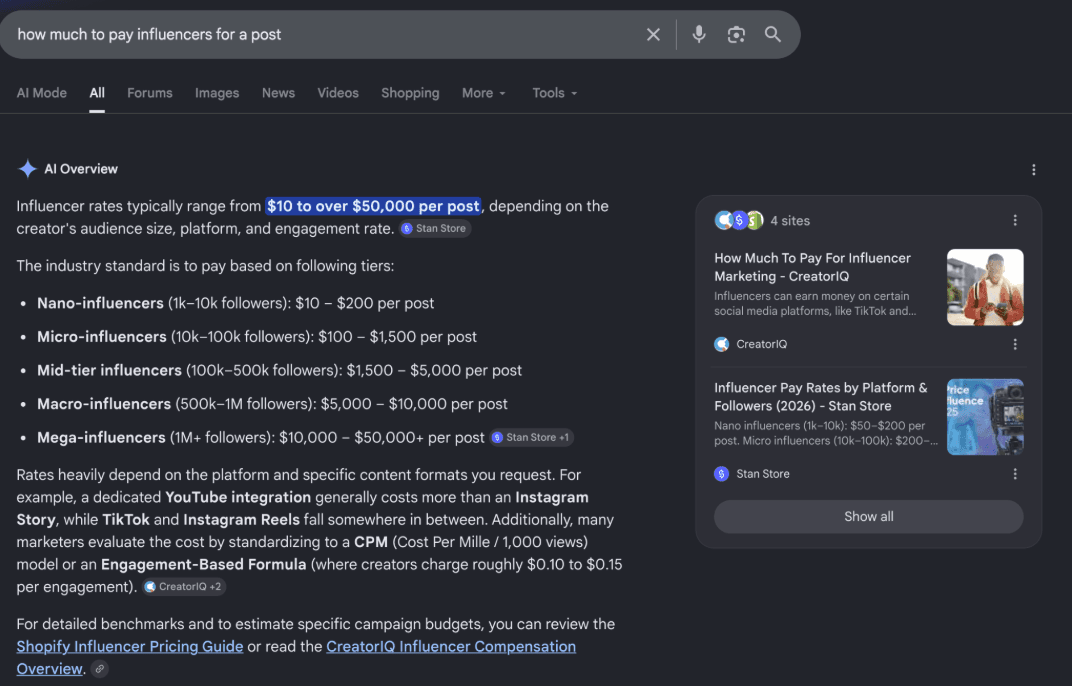
Google "how much to pay an influencer" and nearly every result prices creators the same way: by follower count. The standard rate cards put an account of Elle's size somewhere between $2,500 and $10,000 per post (Influencer Marketing Hub, 2026).
Question 2: for that $10,000, do 238,000 people see the post?
Not even close. Her median reel is viewed about 6,200 times. That's 2.6% of her following. Narrow it to sponsored posts, the ones brands actually pay for, and the median views drop to roughly 3,500. A measly 1.5%.
Two bars showing how few of 238,000 followers see Elle's posts: 2.6 percent on a typical post and 1.5 percent on sponsored posts, the rest represented as ghosts.
More bad news
We've landed on 3,500 views as a defensible estimate. But that still overstates how many people Elle personally delivers to a brand.
- Some views were paid for. At least four of her Reels appear in Meta's Ad Library, meaning brands paid to increase their distribution, driving up the public view number.
- The same person can count twice. Meta's own documentation defines a view as "the number of times a reel or video was played," and in 2024 Meta folded replays into that number and removed the separate replays metric. Views count plays, not people.
- Most of those plays end almost immediately. The only published skip-rate benchmark is Socialinsider's analysis of 140,000 Reels, which found a 60.5% three-second skip rate for accounts in the 100K–1M range. One caveat we won't paper over: that study measures business pages, not creators. Nobody has published the equivalent for creator accounts.
- The ones who stay don't stay long. Metricool's study of 24 million Instagram posts across 375,000 accounts puts average Reels watch time at 8.5 seconds. On a thirty-second sponsored Reel, that's most of the ad going unseen.
So 3,500 views likely translates to somewhere between 1,000 and 1,400 people meaningfully watching, and potentially fewer when the brand paid for part of the reach.

Question 3: how much does that cost?
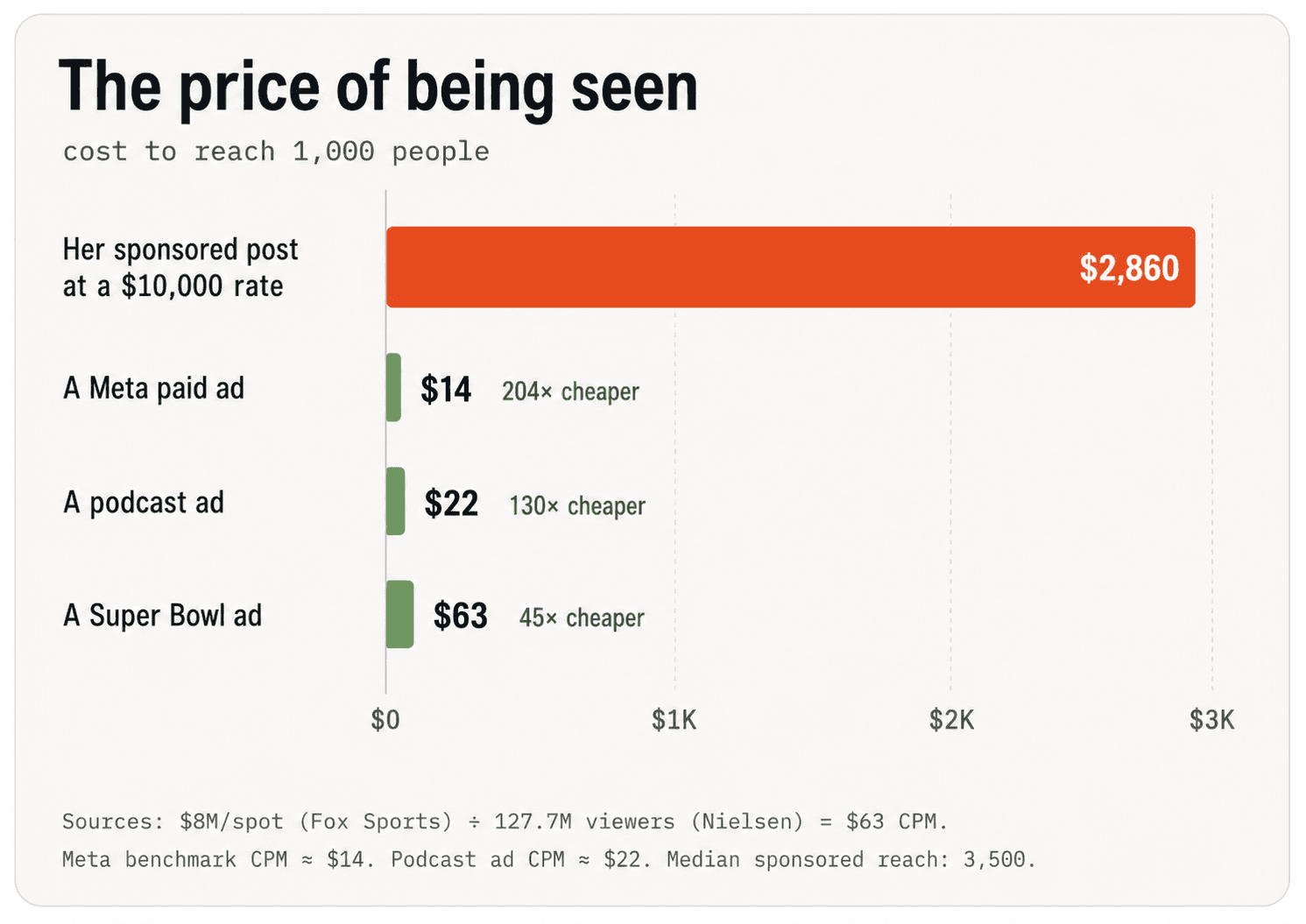
At $10,000 a post, reaching 1,000 of Elle's actual viewers costs roughly $2,860 ($10,000 against a 3,500-view median). A Super Bowl commercial costs about $63 per 1,000 viewers: a record $8 million for thirty seconds in front of 127.7 million people. That means brands are paying nearly 45 times Super Bowl prices to appear in front of roughly 3,500 people.
Question 4: why pick on Elle? Is any of this her fault?
It's not Elle's fault companies are paying her absurd money to put eyeballs on their posts. But the next part is where some intentionally manipulated figures start to present themselves, and we should give credit where credit is due.
Some industry experts will tell you "don't rely only on followers, engagement is more important," when pricing an influencer. The formula every vetting tool, media kit, and rate card runs on is simple: likes plus comments, divided by followers. Elle comes through at about 0.5%. Pretty standard. Experts will also encourage you to read a post's comments, see how deep they go.
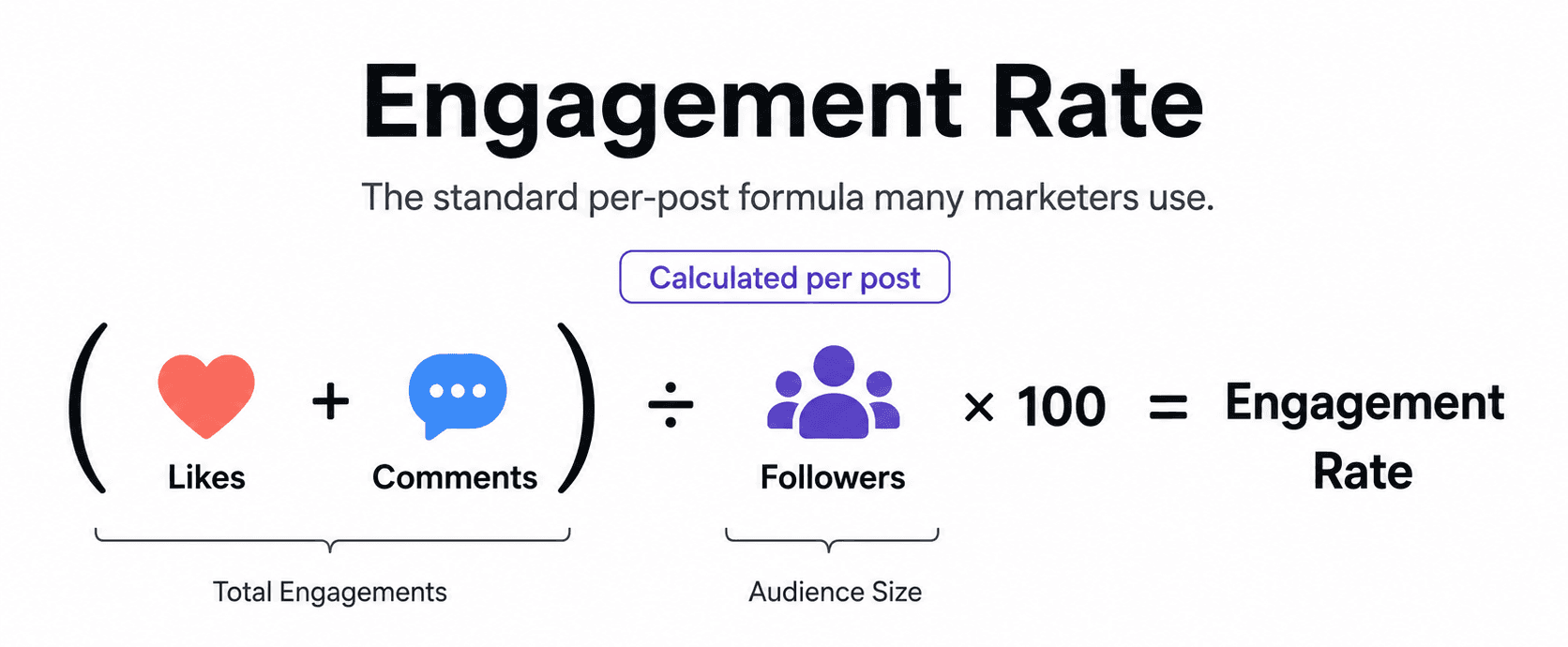
But what happens when you calculate engagement against views, the number of times the video actually appeared on someone's screen? That seems far more meaningful than measuring it against follower count, when we've determined less than 1 in 100 followers are meaningfully watching a video.
This is where it starts to get weird
There is no universal benchmark for engagement rate per post (likes per Instagram view). But common benchmarks generally sit in the low single digits. Elle's median reel: 21 percent. And no, she is not an OnlyFans model.
Side by side comparison: the same post's engagement computed against followers reads 0.55 percent and looks normal, computed against actual viewers it reads 21 percent, four times above the possible organic range.
Her smaller posts get stranger. A video with 2,700 views: 1,220 likes. That's 45 percent. We already know less than half of the viewers complete the video, so how is it that every single one of those is also liking it? The most beloved posts on the internet get nowhere near that. When NASA filmed the Earth setting behind the Moon, the internet lost its collective mind: 9 percent.
All of her reels follow a very specific pattern. A video watched 3,475 times got 1,220 likes. A video watched 16,498 times got 1,418 likes. A video watched 886,956 times got 1,281 likes. The audience swings 255-fold across those three posts. The like count moves by 16 percent. Her likes aren't behaving like applause, where more people means more noise. They're behaving like a delivery. Same quantity, every post, no matter who's watching. Strip out the viral outliers entirely and the pattern holds: plays swing 5x across the middle 80% of her posts. Her likes move 1.58x.
Meet the superfans
A fair pushback: maybe 1,200 people are just really devoted to Elle. Surely those devotees would show up in the comments.
And she does look adored. Hundreds of ❤️👏🔥. "Love this." "Obsessed." To a brand skimming the grid, that reads as purchase intent.
So who are these strong, supportive women? Oh. It's the same names. Over and over. So often that four accounts produce 35% of every comment on her recent posts.
Maybe they're superfans. Let's find out.
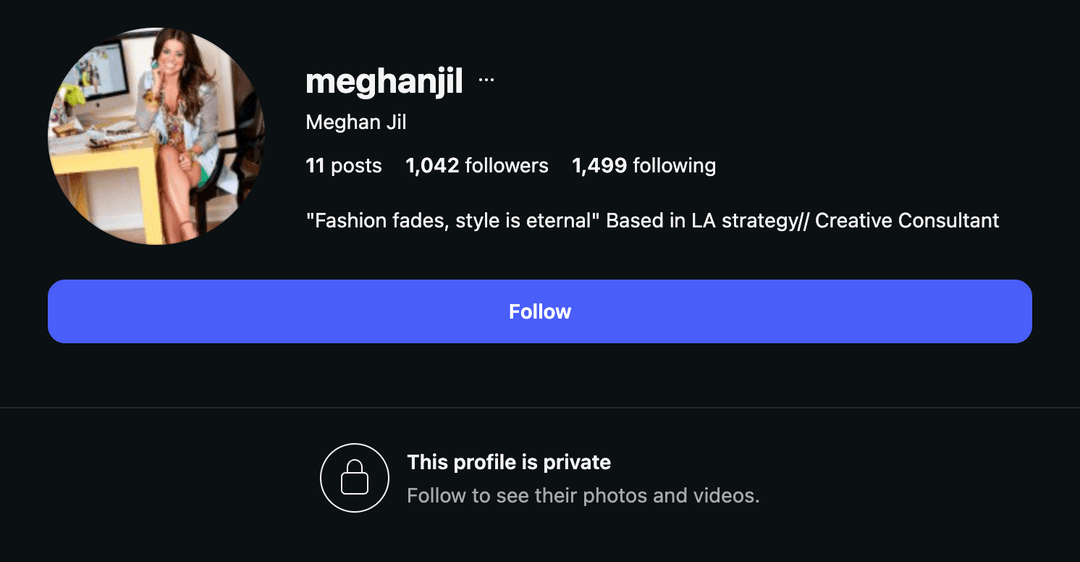
First, Meghan Jil: 10% of all Elle's comments by herself. Private account. The profile photo is a blurry desk-and-blazer shot that looks airlifted out of 2013.
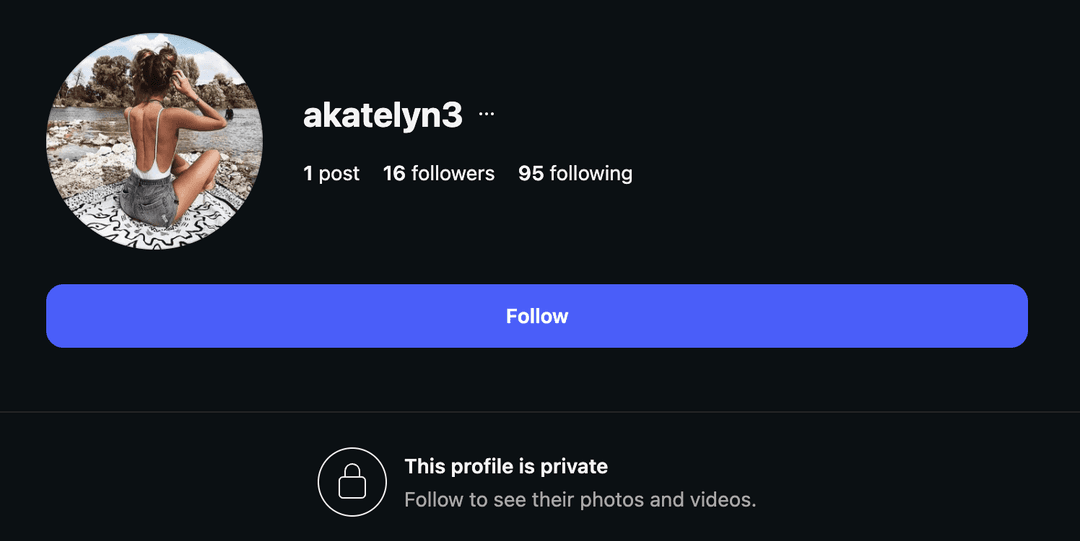
Next, akatelyn: 9.9%. Also private. A Pinterest-style photo, also from the 2010s. One post. Sixteen followers.
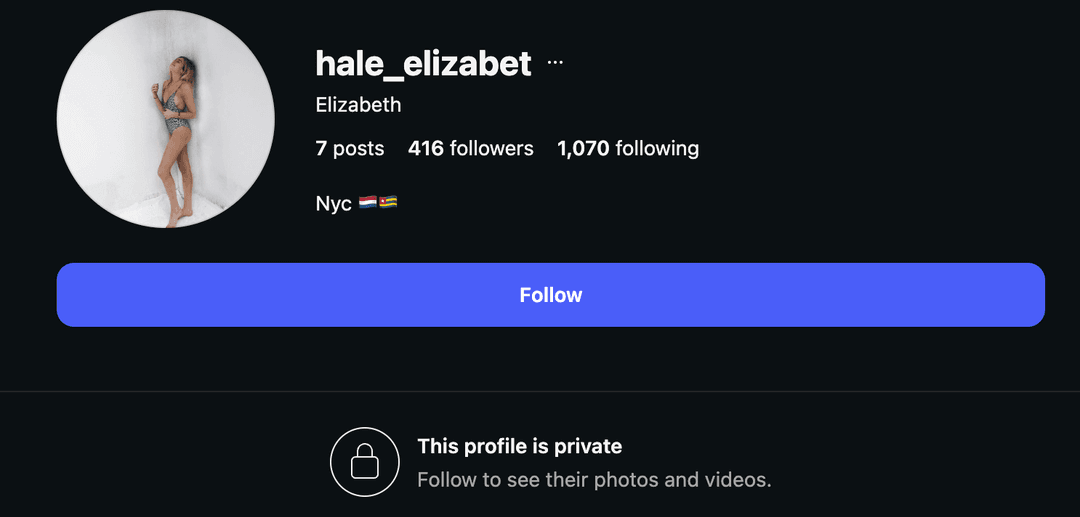
Then hale_elizabet: 9%. Private. And you guessed it, a Pinterest fitness photo from the 2010s.
On a sadder note, Elle never replies to any of them. Any creator will tell you that hugging your biggest fans is rule number one of the job. I couldn't find a single reply. Ever. It's like watching someone ignore the guests at their own surprise party.
And then I looked at the fourth account. brunchnut. It was responsible for 6.2% of Elle's comments, but it looked different from the others. It appeared substantial. Real. A fully built food account with 73,000 followers, years of posts, and an entire life behind it.
But… Elle never replied to brunchnut either.
Then I read the bio.
"We're Elle and (redacted)"
The woman appearing throughout the food account was the same woman on the main account.
Brunchnut was not one of Elle's most devoted fans.
It was Elle.
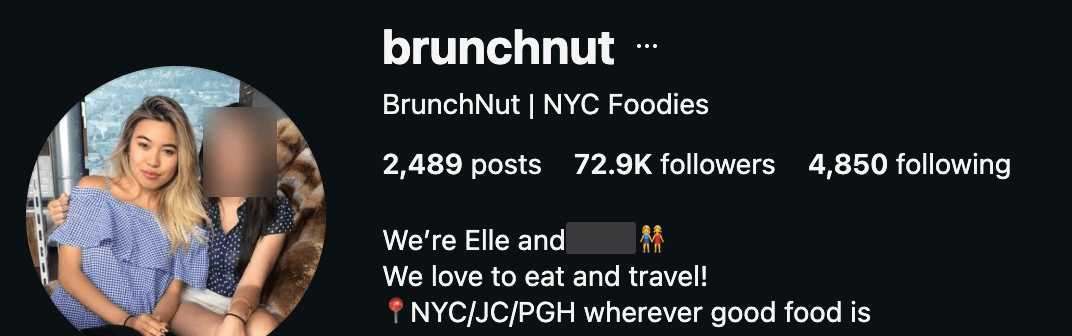
And wouldn't you know it, the comments over on the food blog are left by the exact same three women.
For a moment I thought I'd stumbled onto something genuinely bad. Three women obsessed with her, overwhelming both of her accounts, and she never responds. Maybe she can't get away from them.
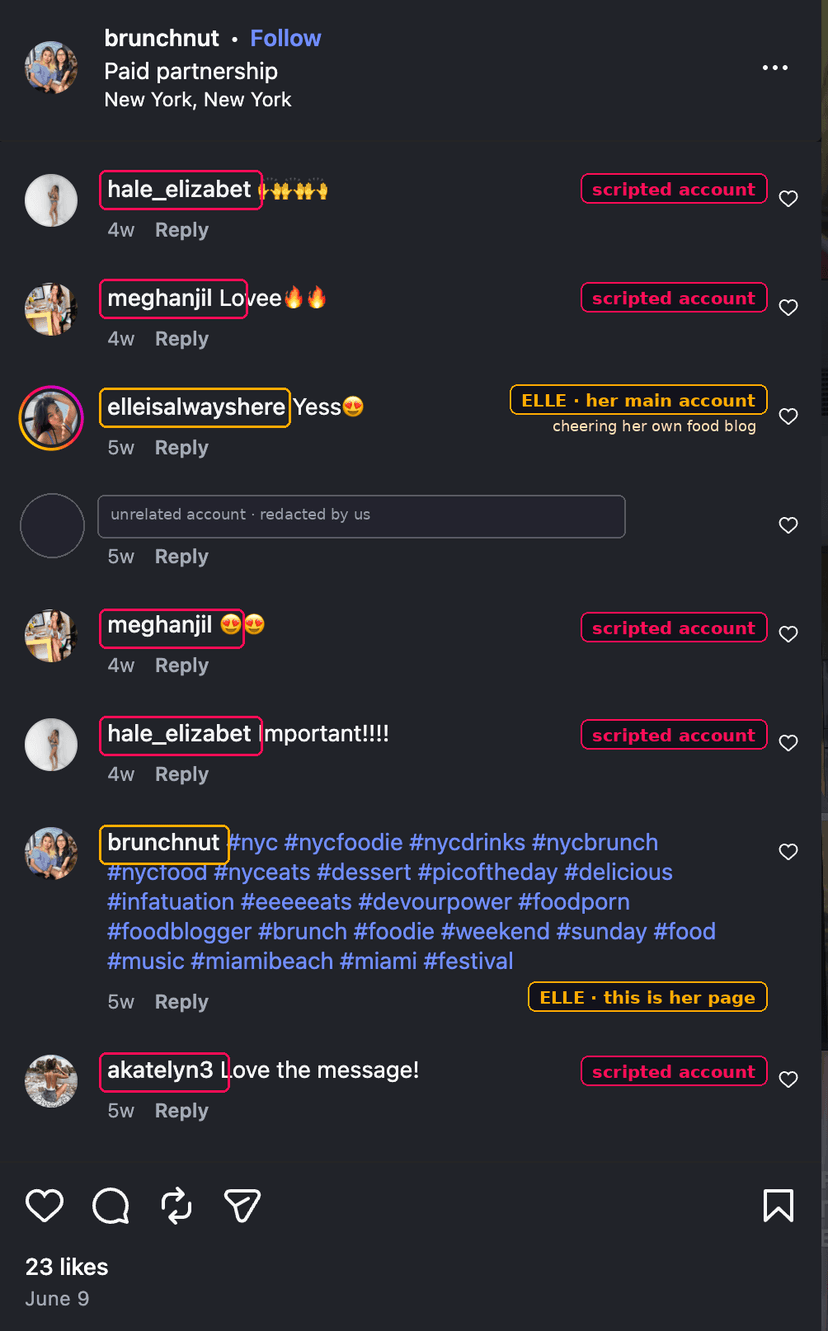
But then I found the food blog's fourth most prolific commenter: Elle's main account. The influencer is a top fan of the food blogger. The food blogger is a top fan of the influencer. And no, Elle doesn't reply to her own comments there either.
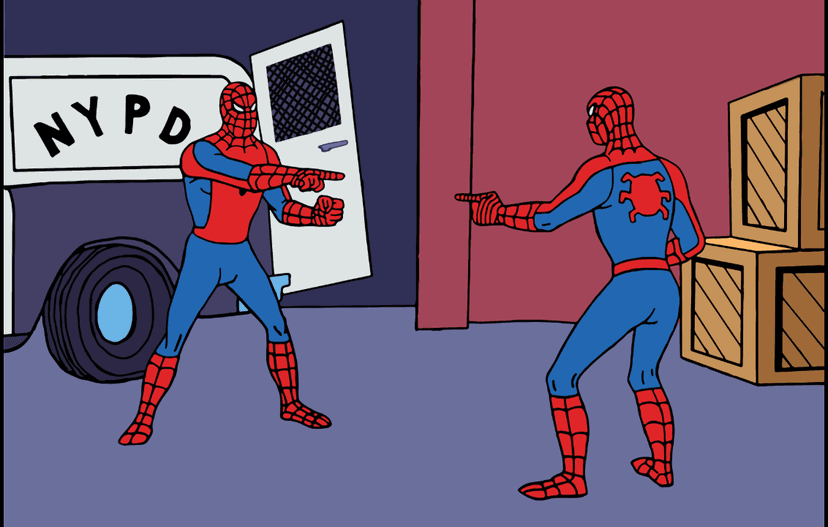
Now hold the two accounts side by side. On Elle's main account, four names produce 35% of every comment. On the food blog, a different-sized account, with a different audience, on a different subject, the same three names plus her main account produce 36%.
Think about how strange that is. Two comment sections. Supposedly two crowds. And the concentration comes out nearly identical, within a single percentage point, as if someone set a dial.
Question 5: can you even prove this?
Yes. I brought receipts.
Real fans are messy. They comment on the bus, at lunch, three days late. Their timestamps look like weather.
So I pulled the timestamps on Elle's three superfans. They don't look like weather. They look like choreography.
Start with Meghan Jil. July 13th, 12:25am. She comments on Elle's newest post. Fourteen seconds later, the next post down. One second later, that same post again. Nine seconds later, the third post. Down Elle's grid she goes, in perfect order, doubling back on some posts, until she's left seven comments on five posts in forty-one seconds. Then she's gone.
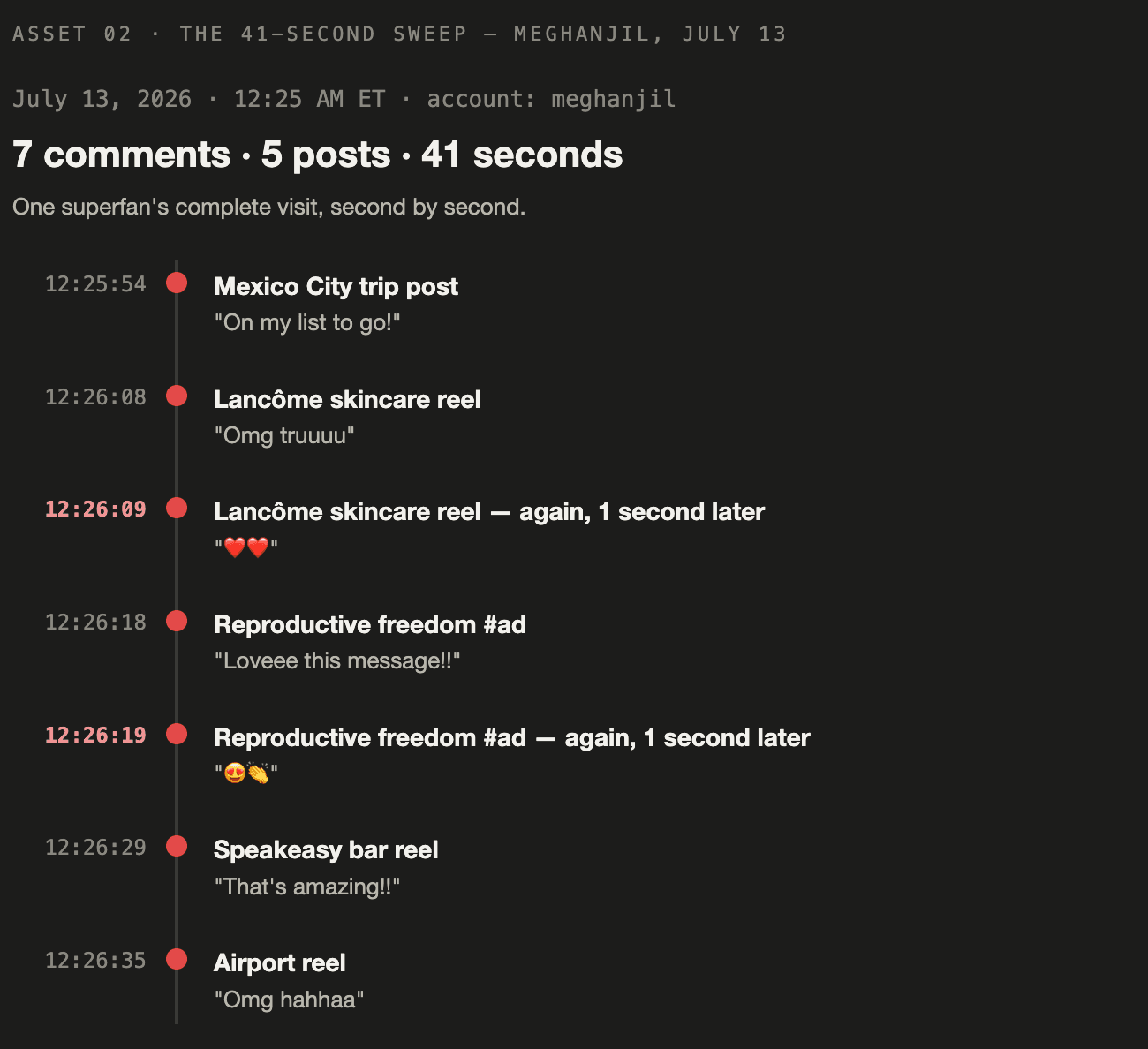
And they take turns. July 2nd, 4:07am: hale_elizabet sweeps the grid in twenty-four seconds. Thirty-nine seconds later, akatelyn runs the same route. Then Meghan Jil. Three accounts, three minutes, never once overlapping. Nearly every post gets this same middle-of-the-night choreography, for months. The only post they skipped was the one that went genuinely viral.
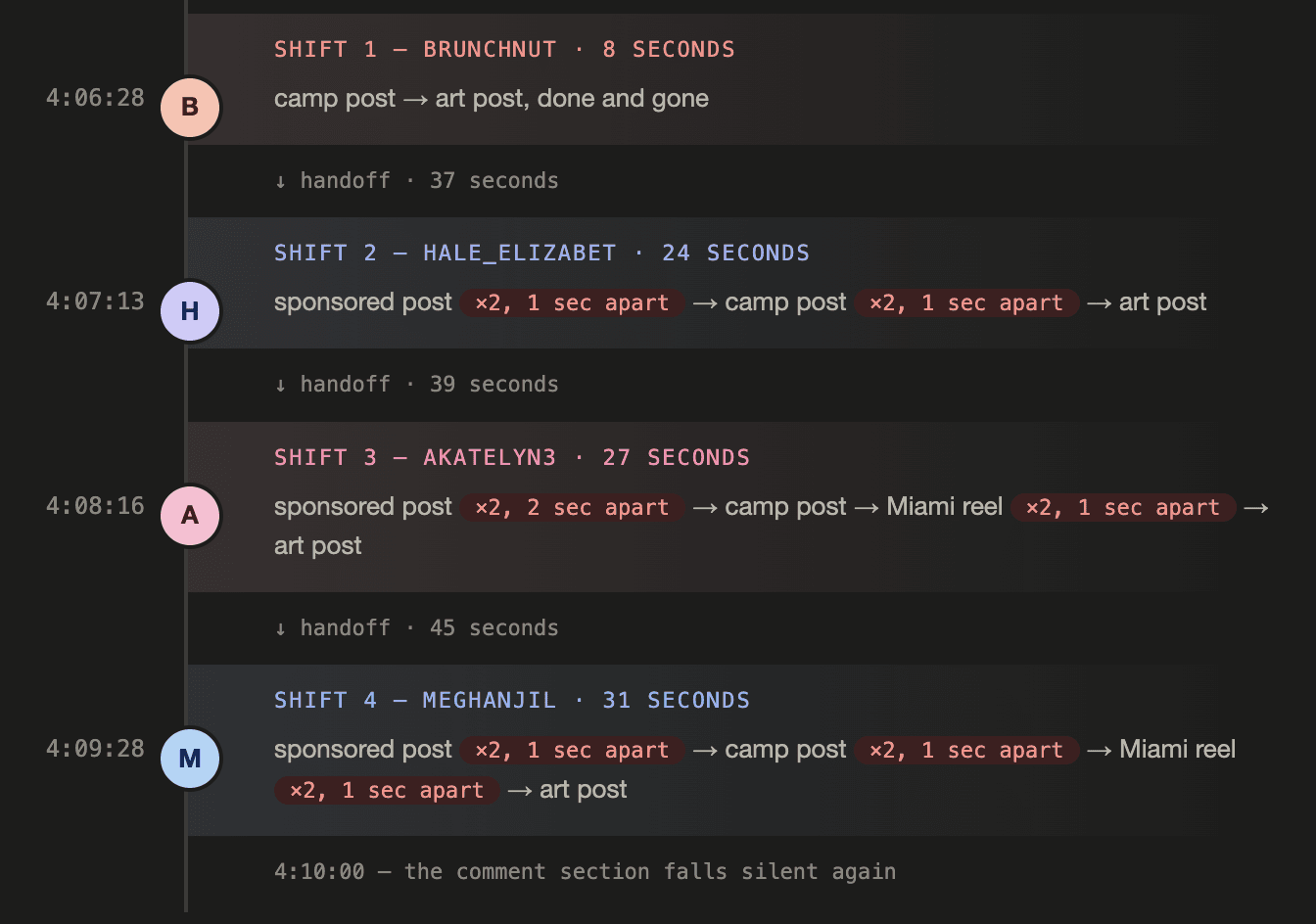
If these are human beings, they're the fastest thumbs on Instagram, working the graveyard shift, in rotation, without pay, for a woman who has never once replied to them.
And the three ghosts are just the start. Sixteen accounts produce 68% of all the comments on Elle's everyday posts. Two of the sixteen are Elle. Most of the rest appear to be other influencers.
Which raises a question we didn't expect to be asking when this started: how deep does this go?
This is what's left when you remove everything that isn't a person
Let's do the thing no influencer vetting tool does. Take Elle's numbers and strip out everything that doesn't behave like a human.
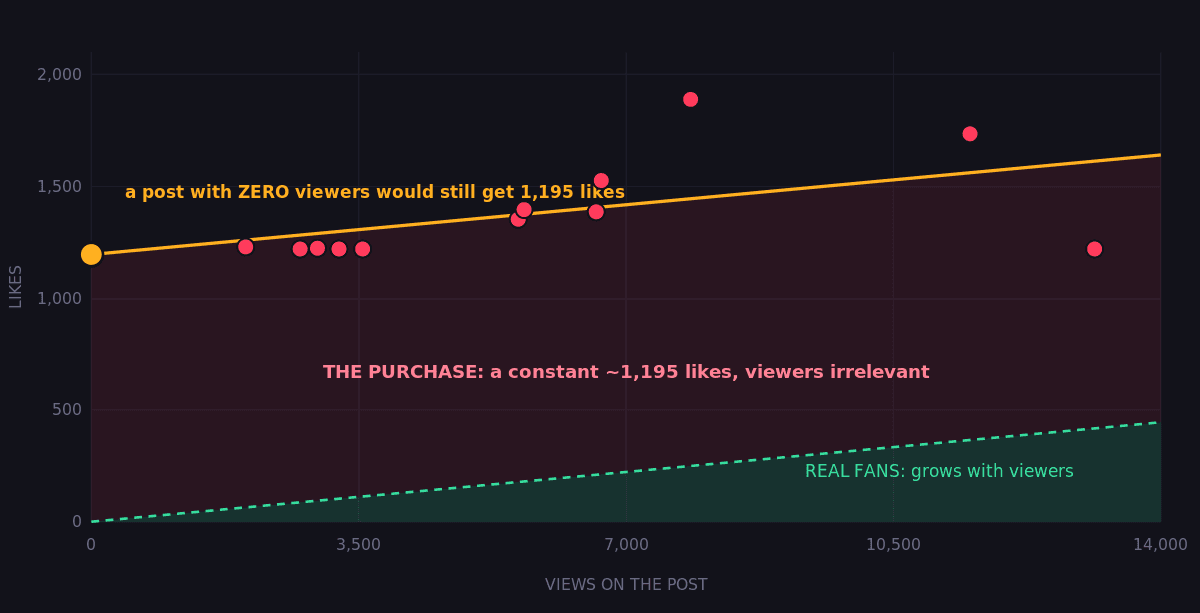
Start with the likes. Almost every post lands at about 1,200 whether 2,700 people watched or 886,000. Call that 1,200 the machine's share: it shows up on day one, every post, like a standing order. But sitting on top of it is a faint signal. Posts more people watch earn slightly more likes. That sliver, the part that actually responds to viewers, is her real audience. You can measure it.
For every 1,000 real people who watch an Elle reel, about 26 like it. That's 2.6 percent, and here's the twist: it's a completely normal, healthy rate. Her real fans behave exactly like regular humans. There just aren't very many of them.
The next part is completely speculative
This last part is completely speculative. It's just me, guessing. But I've earned a guess.
My guess: the real Elle has about 25,000 "authentic" followers. And here's the thing, 25,000 followers is good. That's a legitimate micro-influencer. That's a person brands would genuinely pay... three hundred to five hundred dollars a post.
Which appears to be the problem. Somewhere along the way, I suspect Elle did the same math I just did, in the other direction. A $400 creator wearing a $10,000 costume nets $9,600 per post, and the costume costs about $315 a month. Better margins than movie theatre popcorn.
And the industry keeps fitting her for it. Because as far as I can tell, every major vetting tool still leads with the same two numbers, followers and a rate divided by those followers, which is a bit like auditing a restaurant by counting the chairs. Nobody asks if anyone's eating.
Every brand on her grid did exactly what the playbook says: check the follower count, check the engagement rate, pay the standard rate. Follow those steps and you end up paying $50 to $200 for each genuine human reaction — and that's if she's at the bottom of her rate card. Not each customer. Not each click. Each like.
Somewhere at every one of these companies there's a finance team that would shut down a Google campaign over a $15 cost-per-click. What would happen if they found out an influencer line item was running two hundred dollars to drop a heart emoji?
What we know, and what we don't
To be clear about what we know and what we don't: we can't confirm who is in charge of the automated activity or how much Elle is getting paid. What the data shows is that the overwhelming majority of this account's engagement does not behave like human beings, and that the account benefiting from it operates one of the accounts producing it. If there's an innocent explanation, we'll happily publish it.
We do know this sounds like a bad deal, and that there are many, many more instances like it. To check an influencer yourself, try this.
None of this required special access. It required looking. Every brand on Elle's grid had the same public data we did, and a checklist that was never designed to read it. That's the gap: not that fraud is sophisticated, but that the standard vetting process measures the three things easiest to manufacture and none of the things that are hard to fake. For the tier where this concentrates, see the riskiest follower tier. For how the money adds up across an industry, see influencer fraud statistics for 2026.
Before you wire a creator five figures, run a free receipt on their handle and see whether their likes actually follow their reach. Or pressure-test the quote itself with the Influencer Pay Calculator. It takes less time than reading the media kit you were about to trust.
Run a free receipt on any creator — just your email. No card, no trial.
The brands on her grid
Twenty-two sponsored posts in the sixty-day window, across nineteen brands. Roughly one every three days. Two of them carry no disclosure in the caption at all; we found those through the advertisers' own partnership ads in Meta's Ad Library.
- Pfizer / Nurtec ODT (×2 posts — #PfizerSponsored #NurtecODTPartner)
- MaryRuth Organics (×2 — #maryruthspartner)
- Manucurist (×2 — promo code ELLERY15)
- Equinox (#equinoxpartner)
- GUESS Watches (#GUESSWatches campaign)
- Space Needle + Chihuly Garden and Glass (#ad, plus their partnership ads in Meta Ad Library)
- Raw Sugar Living + Target (#ad)
- Ritual (#ritualpartner, plus affiliate link in bio)
- Hempz + Amazon (#hempzpartner #ad)
- Cozey (undisclosed in caption; confirmed via their partnership ad in Ad Library)
- Mazda USA (#mazdapartner)
- Zoox — Amazon's robotaxi (#ad)
- CeraVe + Walmart (#CeraVePartner)
- Sony Electronics (#SponsoredbySony)
- True & Co + Amazon (#ad #trueandcopartner)
- Eggland's Best (#EBpartner)
- Home of Football NYC via Fever (paid-partnership flag, caption undisclosed)
- Reproductive Freedom for All (#RFApartner)
- Eternal Water (#eternalwaterpartner, at a Daily Front Row event)
Methodology & sources
The data. All figures come from public Instagram data for @elleisalwayshere and @brunchnut, collected with a standard scraping tool across four snapshots (June 22, July 2, and July 13, 2026, plus a same-day comment pull). Core dataset: the 60 most recent reels on the main account (April 19 to July 13), including play count, like count, comment count, captions, and timestamps; the complete comment sections (author, text, timestamp) of the 12 most recent posts, 204 comments in total; and the 24 most recent posts on each account for the two-account comparison. Nothing here uses private data, leaks, or sources. Anyone with the same tools can reproduce it.
One note on precision. Live account data naturally ebbs and flows. Counts tick up and down between any two moments as posts accumulate views, comments get added or deleted, and Instagram prunes accounts, so if you check a figure today it may sit a few likes or a few hundred plays from where our snapshot caught it. None of the findings depend on any single number. They depend on patterns measured across dozens of posts and multiple snapshots, and the natural drift is orders of magnitude smaller than the anomalies described. In fact, the one place drift itself became evidence is the like decay: normal ebb and flow moves in both directions, while her like counts moved down, in unison, on 40 of 40 unboosted posts.
Like rates. A post's like rate is likes divided by views. To test Elle's account, we compared the like counts on all 58 reels with view data from her last three months, posts whose viewership ranged from 2,350 views to 886,956, a 377-fold spread. Forty-three of the 58, three quarters of everything she posted, landed inside a single 204-like window: between 1,188 and 1,392 likes. The standard deviation of that group is 64 likes, on posts whose audiences differed by more than two orders of magnitude. For the like counts to be this uniform while viewership varies this wildly, the likes cannot be a function of who watched. We concluded they arrive in a fixed quantity per post, and the regression analysis measures exactly how large that fixed quantity is.
Separating real likes from purchased ones. Every account's likes fit one equation: likes = (fan rate × views) + baseline. Real fans scale with viewership; a purchased block does not. We fit a standard linear regression through her routine (non-viral, non-boosted) posts. The slope, about 26 to 32 likes per 1,000 viewers depending on the sample, is her real fans, and it sits inside the normal human range. The intercept, roughly 1,190 to 1,200 likes, is what a post would receive with zero viewers. Organic accounts have an intercept near zero. "About 140 real likes on a typical post" is the median of (likes minus intercept) across her organic posts; the same answer emerges from two independent methods within about 20 likes. We also adjusted for the fact that like counts decay over time (see next note); it changed the result by less than 10 likes.
The decay. Between our three snapshots, 40 of 40 unboosted posts lost likes, at roughly half a like per post per day, consistent with the platform's ongoing removal of inauthentic accounts. Posts that gained likes during the window all had brand ad campaigns running on them, which we verified in Meta's public Ad Library.
The comment analysis. Commenter shares (the four accounts at ~35 percent; sixteen accounts at 68 percent of everyday-post comments) are computed from the 204-comment dataset, excluding her one viral post, which drew a genuinely organic crowd. Timestamps are as recorded by Instagram, converted to Eastern Time. The identification of brunchnut as Elle's account rests on its bio and matching photographs.
The money. We have not seen Elle's invoices. Per-post rates ($2,500 to $10,000+) are industry rate-card ranges for accounts of her size from published pricing guides, with premiums for pharma and ad-usage rights. Cost-per-thousand comparisons use those rate cards against her measured views; the Super Bowl figure uses a ~$8M spot price against ~128M viewers (Nielsen).
Frequently asked questions
- How do you spot fake Instagram comments?
- Look at who comments and when. On this audited account, four accounts produced 35% of all comments, and their timestamps arrived in bursts — one account left seven comments on five consecutive posts in 41 seconds, straight down the grid in order, at 12:25am. Real audiences comment irregularly, across hours and days. Tight, ordered, repeating bursts from the same small set of accounts indicate scripted activity.
- What is a normal like-to-view ratio on Instagram?
- There is no universal published benchmark, and common engagement benchmarks sit in the low single digits — so the ratio matters less than whether it moves. On a real account, likes rise and fall with plays. On the audited account they don't: strip out the view outliers entirely and plays still swing 5x across the middle 80% of her posts (3,270 to 16,498) while likes move just 1.58x (1,195 to 1,888). Her median reel scored 21% of viewers, and one post hit 45% — the signature of likes arriving independently of anyone watching.
- Why doesn't engagement rate catch influencer fraud?
- Because the standard formula divides likes and comments by followers, not by the people who actually saw the post. That hides two problems at once: an account can reach a tiny fraction of its followers, and its likes can be purchased at a fixed volume. This creator scored a comfortable 0.5% while her true rate, measured against real humans, was 0.06%. See how Instagram's engagement rate hides fraud.
- How much are brands overpaying for fake influencer audiences?
- At a $10,000 rate card and a median sponsored reach of 3,500 viewers, a brand pays about $2,860 per thousand people reached — roughly 45× the ~$63 CPM of a Super Bowl ad ($8M per spot ÷ 127.7M viewers). Measured against real engagement (about 49 genuine likes on the median sponsored post), that's $50 to $200 per human reaction, depending where in the $2,500-$10,000 rate card she lands.
- Can I check a creator's engagement myself before paying?
- Yes. Compare a creator's biggest and smallest recent posts: if the view counts differ wildly but the like counts are close, the likes aren't responding to reach. Then check whether the same handful of accounts appear in every comment section. Run a free receipt to see every post plotted and the baseline flagged automatically.
Get the receipts in your inbox.
New data on influencer pricing, fake engagement, and how to vet creators. A few times a month, no spam, unsubscribe anytime.